July 2026 Market Summary
International cotton prices as measured by the Cotlook A Index rose by 445 cent points overall last month. July 31 also marked the last day of the current season, and the expiry of the 2025/26 A Index. The final value of 90.00 cents per lb compares to a high of 97.65 attained on May 14, 2026. A low of 72.55 was recorded on February 9 this year while the average for the 12-month period was 80.05 cents per lb.
From August 1, the 2026/27 A Index (henceforth the Current Index) will stand alone until after the year-end, when a new Forward (2027/28) A Index will be introduced as soon as sufficient market evidence is available.
Henceforth, the US Adjusted World Price will be calculated according to a base value of 55 cents per lb instead of 52 cents per lb, in accordance with adjustments outlined in the One Big Beautiful Bill Act of 2025.
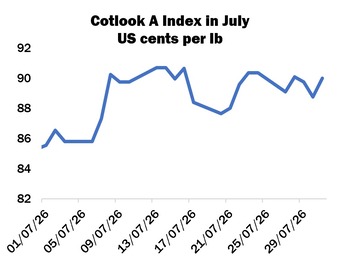
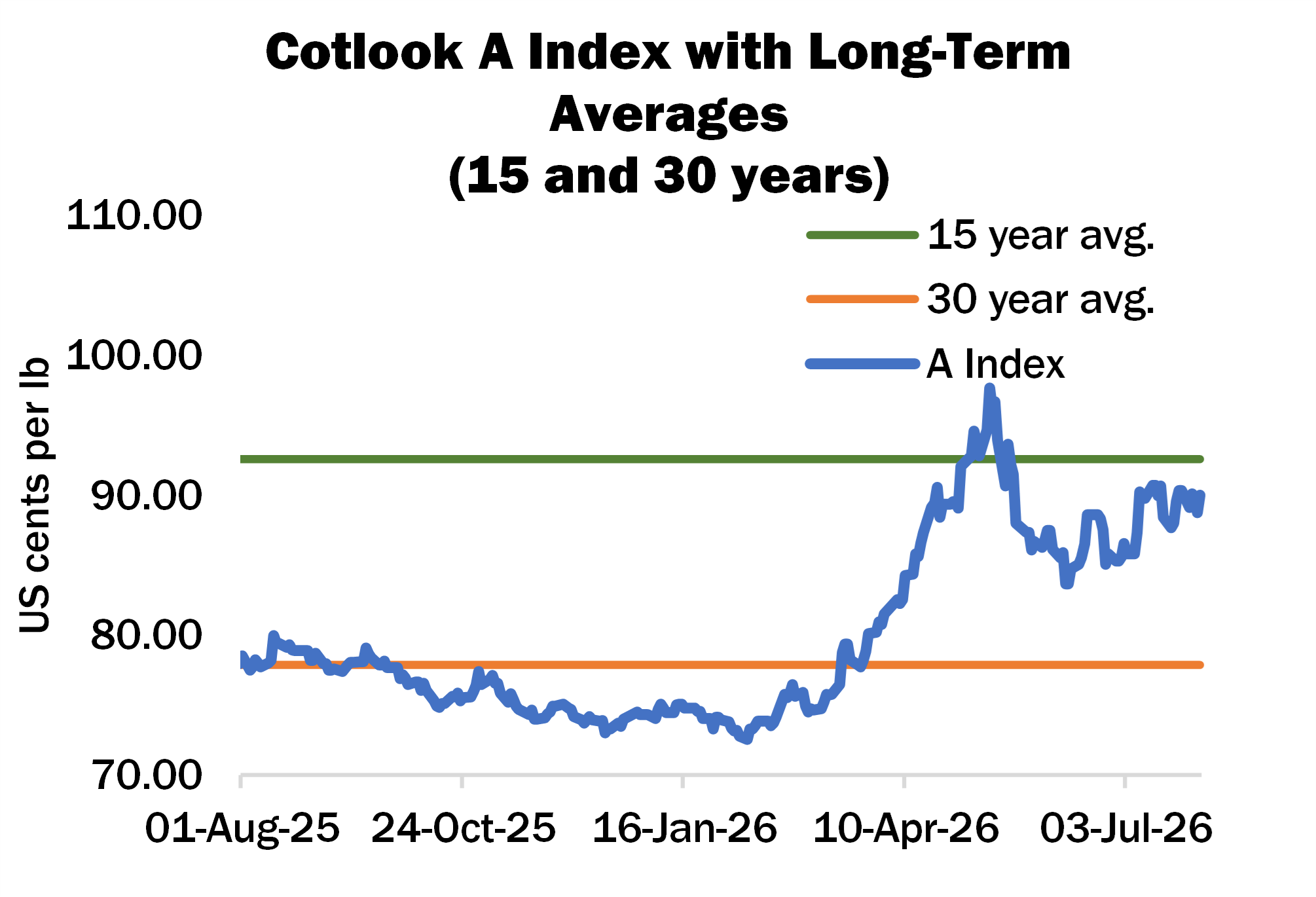
In the physical market, import buying was relatively subdued for the most part, although activity picked up when futures dipped below the 80-cent mark. West African and Brazilian lint continued to attract interest in Bangladesh, but business was price sensitive. Reports of difficult operating conditions for spinners persisted. The same origins also encountered demand in India, although the duty-free import window is set to expire on October 31. Some mills in Pakistan turned to the international market again as domestic new crop arrivals were disrupted by wet weather. Machine-picked cotton available for nearby shipment found buyers in Vietnam when prices moved lower. Slower activity was reported in Turkey, in line with seasonal norms.
Meanwhile, the US government introduced tariffs on goods from 60 countries under Section 301 of the Trade Act (relating to forced labour), replacing a temporary 10-percent rate that was installed after the Supreme Court decision in February to strike down last year’s “reciprocal” regime. Imports – including apparel and cotton products – from China, Vietnam, Turkey and Egypt will now attract a 12.5-percent tariff, while those from India, Pakistan and Bangladesh have a slightly more advantageous rate of 10 percent.
US export reports showed slower sales for the current marketing year, while upland commitments for 2026/27 rose significantly in the week ended July 23, increasing by a net 352,400 running bales. Shipments across the four weeks in view totalled 955,000 bales, bringing accumulated exports for the season to almost 10.91 million bales, versus 11.01 million a year earlier.
By July 26, cotton squaring and boll setting across the US were both on a par with the five-year averages, at 81 and 45 percent respectively. The proportion of stands described as being in ‘good to excellent’ condition was 46 percent, versus 48 percent by June 28. Those rated as ‘fair’ were 38 percent (36 a month earlier), while 16 percent were ‘poor to very poor’ (unchanged).
In the latest WASDE report, USDA raised its domestic production forecast by 400,000 bales, to 13.7 million, perhaps reflecting the improved soil moisture profiles in some key areas. Other figures were unchanged, so ending stocks rose by the same proportion, to 4.1 million bales. For the global balance sheet, output was also increased, from 116.04 million bales to 117.26, while consumption and trade were raised modestly. Beginning stocks were lower compared to the June estimate, and ending stocks edged up slightly to 71.22 million bales.
On July 14, the China National Cotton Reserves Corporation announced that a series of State Reserve auctions would commence from July 20, allowing the rotation of old stocks and/or in response to rising futures and physical prices since late autumn.
Around 80,200 tonnes were offered across the auctions between July 20 and July 31, all of which found buyers. The catalogue comprised 28 percent of Xinjiang cotton from the 2019/20 season, 54 percent of US lint (2020/21 and 2021/22 crop), and 18 percent Brazilian (2019 and 2021). The average prices paid declined slightly across the period, particularly for Xinjiang supplies, but remained above the weekly base prices.
The lead September contract on the Zhengzhou cotton futures platform settled in a range of 605 yuan in July, ending the month 300 yuan lower overall at 15,780 yuan per tonne. Uneven crop development was reported across the key Xinjiang region as stands were affected by high temperatures and water shortages.
Meanwhile, planting accelerated in India. By July 24, around 9.87 million hectares had been sown to cotton nationwide, four percent below the figure reported at the same moment a year earlier, versus a 35-percent deficit reported at the end of June. Rainfall across the country during the monsoon season so far was 15 percent below the Long Period Average by July 29, compared to a 40-percent difference a month earlier. Precipitation in the important Central region had improved to near normal.
Monsoon activity picked up in Pakistan, with some developing stands benefiting from the moisture following prolonged heatwaves, while in other fields pest infestations increased and picking was disrupted. The quality of recent arrivals was also affected somewhat, putting pressure on prices. According to the PCGA, seed cotton deliveries by July 31 amounted to 785,800 bales, up 32 percent on the year, with Sindh accounting for 62 percent of the total.
In the Southern Hemisphere, harvesting expanded in Brazil, although wet weather may have impacted the quality composition of the crop. Work was around 17 percent complete nationwide by July 24 according to CONAB, while IMEA indicated that 13 percent of the crop had been gathered in the largest producing state, Mato Grosso. Poor weather had frequently interrupted harvesting in Argentina, so work was still yet to be concluded. Picking was complete in Australia, with attention turning to the next crop amid concerns that dry conditions could impact prospects.
Cotton Outlook’s projection of global raw cotton production in 2026/27 was reduced by 402,000 tonnes in the month, to 25.24 million tonnes, attributed to lower figures for several key countries. Our consumption forecast was meanwhile increased by 229,000 tonnes to 26.38 million. The result would be a reduction of global stocks by the end of the next marketing year of 1,148,000 tonnes, versus the 517,000 put forward last month.
For the nearly concluded 2025/26 season, our world output figure was raised modestly to 26.73 million tonnes, while consumption was increased by a smaller margin to 26.55 million owing to adjustments for some of the major markets. The estimated addition to global stock levels by August 31, 2026, therefore widened to 184,000 tonnes.