August 2026 Market Summary
International cotton prices as measured by the Cotlook A Index increased by 1,130 cent points overall last month, to be placed on August 28 at 101.30 cents per lb, its firmest level since May 2024. In New York, the lead December contract recorded fresh lifetime high settlements, reaching 93.14 cents per lb on the last day in August, up from 81.79 cents on July 31. Significant pressure on shippers’ basis offers was witnessed, particularly for Brazilian lint, in view of rising futures, slow mill demand and the sizeable physical holdings of merchants.
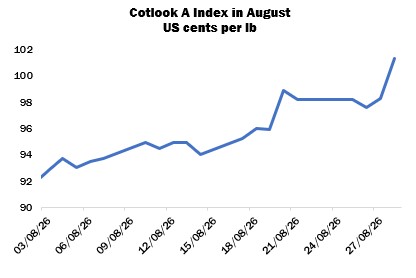
Despite basis concessions, physical business remained limited as mill buyers were reluctant to commit to purchases amid the volatility, especially since yarn prices had not kept pace with the rapid rise in futures in many cases, squeezing spinners’ profit margins. Furthermore, downstream demand was tepid, and few signs of recovery were apparent even as the traditional ‘peak season’ for textiles orders approached.
Some sales were concluded in Bangladesh for the usual West African and Brazilian lots, but mills here continued to struggle with energy supply issues limiting operations. Competitively priced lint changed hands occasionally in Pakistan and India, and limited prompt shipment supplies were bought in Vietnam during dips. Activity in Turkey remained limited in view of the European summer holiday season and persistent liquidity problems.
US export reports demonstrated the slower pace of physical business, as weekly net upland sales declined from 140,500 running bales in the August 1-6 period (the first days of the new season), to just 27,500 in the week ended August 27. Shipments over the four weeks in view amounted to 733,000 bales.
Meanwhile, boll setting across the US cotton belt by August 30 was placed at 89 percent versus the 91 percent average, and openings stood at 29 percent, up one point from the average. Crop health deteriorated over the month under very hot, dry conditions. The proportion of stands described as ‘good to excellent’ was 39 percent by the end of August, versus 46 percent by July 26. Those rated as ‘fair’ were 29 percent (38 a month earlier), while 32 percent were ‘poor to very poor’ (16 percent).
Perhaps in reflection of the declining crop conditions, USDA cut its estimate of domestic production slightly to 13.61 million bales in its latest WASDE report, while leaving other figures unchanged. For the global balance sheet, the Department increased its projections of production, consumption and trade while beginning stocks were lowered, resulting in a reduction of ending stocks to 69.69 million, down from the 71.22 million put forward in July.
In China, the lead January contract on the Zhengzhou cotton futures platform advanced strongly to be placed on August 31 at 17,165 yuan per tonne, a gain of 940 yuan from the end of July and its firmest level since May.
All lots offered via the State Reserve auction programme in August found buyers, bringing the tally to almost 248,700 tonnes. Of the cotton sold so far, 30 percent consisted of Xinjiang supplies from 2019/20, while 48 percent was of US origin (2020/21 and 2021/22 crop) and 22 percent Brazilian (2019 and 2021).
The weekly base price increased over the course of the month, to be placed at 17,228 yuan per tonne on August 31, while the average prices paid were between two and six percent greater than the base level.
In China’s key Xinjiang region, cotton bolls were opening and growers were preparing for the harvest. However, varied crop development was reported following persistent high heat, with drought-affected fields facing lower yields versus those with sufficient irrigation.
Picking expanded in Pakistan under largely favourable conditions, and more ginning factories commenced operations. The overall health of the crop was described in positive terms, and pest infestations were limited. According to the PCGA, seed cotton deliveries by August 31 amounted to 1.7 million lint equivalent bales, up 27 percent on the year, with Sindh accounting for 67 percent of the total.
In India, planting was roughly on a par with the same moment a year ago, closing the gap that had been observed since June. Countrywide rainfall in the Monsoon season thus far was 13 percent below the Long Period Average by August 28, while precipitation in the key cotton-growing central region was three percent below normal.
As for the Southern Hemisphere, picking was in full swing in Brazil with progress placed at around 82 percent by the end of the month, ahead of last year and about on a par with the two seasons before that. Some local output estimates were raised. Harvesting in Argentina, meanwhile, has been persistently disrupted by unhelpful weather. Early sowing of the next crop began in parts of Chaco Province. In Australia, ginning approached a conclusion and almost all the 2026 crop had been committed to trade hands.
Cotton Outlook’s forecast of world raw cotton output in 2026/27 was reduced by 109,000 tonnes in August to 25.13 million, owing to a downward revision for the United States. Our projection for consumption was meanwhile increased modestly to 26.47 million tonnes, attributed to India. The result would be a reduction of global stocks by the end of the current marketing year of 1,342,000 tonnes, versus the 1,148,000 put forward a month ago.
For the now concluded 2025/26 season, our global production figure was adjusted slightly to 26.78 million tonnes in view of higher figures for Brazil and Australia, while world consumption was maintained. The estimated addition to global stock levels by August 31, 2026, therefore increased to 231,000 tonnes.