December 2025 Market Summary
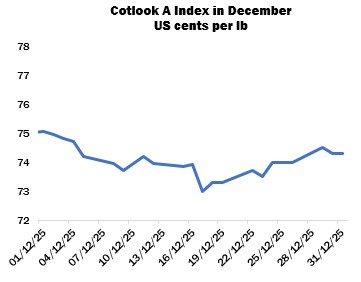
International cotton prices as measured by the Cotlook A Index ended the month at 74.30 cents per lb, a decline of just 65 points, having reached a low on December 17 of 73.00 cents, its weakest value since October 2020. In New York, a similar trend was observed as the lead delivery settled within a range of just 153 points for an overall loss of 44 points. March had recorded a new contract low close of 63.1 cents in the middle of the month before regaining modest ground. Daily volumes were notably lower than the record quantities traded in November when positions were rolled from December to March, while open interest remained robust.
Hand to mouth mill buying continued, but activity slowed slightly further as holiday considerations came to the fore later in the month. Brazilian remained the origin most frequently mentioned, although some spinners turned to US cotton with greater enthusiasm, such as those in Vietnam (as demonstrated in US export reports, detailed below). Steady demand was reported in other Far Eastern markets, albeit for modest volumes to meet spinners’ nearby requirements. Some import interest was noted in Pakistan for various origins, although many larger enterprises had already covered their needs for the first quarter of 2026 and local supplies were still available, particularly lower grades.
Regular enquiry was issued in Bangladesh, mostly for West African and Brazilian lots, with an increased focus on sustainability certifications, but spinners still faced difficult operating conditions. It was announced on December 11 that elections are set to take place on February 12, 2026, the first since then Prime Minister Sheikh Hasina was forced to resign last summer. It is hoped that confidence in the domestic market could be boosted if the election runs smoothly, thus leading to an increase in export orders.
Meanwhile, US upland export commitments increased by a net 774,600 running bales in the four weeks to December 25, boosted by a marketing-year high of 304,700 running bales in the second week. Vietnam was the principal customer in all four reports. The additions brought the running total of commitments to all destinations to 6,499,586 bales, compared with 7.61 million by the corresponding moment in 2024. Cumulative shipments amounted to 2,832,308 bales by the same date, versus 2.67 million last year.
In its December update, USDA further increased its estimate of domestic production in the current campaign, to 14.27 million 480-lb bales (14.12 million in November), largely owing to higher yields in the Delta and Southeast. Exports were unchanged, while mill use was reduced, so ending stocks were raised from 4.3 million to 4.5 million bales. As for the global balance sheet, output was reduced slightly on account of lower figures for the African Franc Zone, partially offset by the adjustment for the US. Consumption was also lowered by a similar margin, resulting in a small addition to the forecast of ending stocks to 75.97 million bales.
The May contract on China’s Zhengzhou cotton futures platform rose by 880 yuan overall in December, closing the month at 14,550 yuan per tonne, a contract high settlement. The strength was attributed partly to an expectation that the area dedicated to cotton in Xinjiang may be reduced next year as well as relatively robust domestic demand.
Data from the China National Cotton Exchange indicated that 6.25 million tonnes of lint had been inspected in Xinjiang by the end of the month, from a total of 1,015 ginners in the region. Progress stood 15 percent ahead of the same moment a year earlier.
In Pakistan, attention was turning to new crop prospects while modest quantities of seed cotton continued to reach gin yards. Winter rainfall was limited so far, raising some concerns regarding water availability for the upcoming growing season. According to PCGA, arrivals by December 31 amounted to 5.4 million lint equivalent bales, on a par with the same date in 2024.
New crop arrivals jumped to their typical December peak in India. The Cotton Corporation of India had procured around 2.85 million tonnes of 2025/26 crop seed cotton by the end of the month, equivalent to perhaps 20 percent of the total expected output. Auctions of cotton from the 2024/25 campaign continued, and the quantities sold in each session increased compared to those recorded in November.
In the Southern Hemisphere, early planting commenced in parts of Brazil, reaching perhaps 25 percent complete by the end of the month, while ginning of the 2025 crop approached a conclusion. ABRAPA projected 2026 output at 3.83 million tonnes, while CONAB favoured a figure of 3.96 million. Rainfall in Argentina resulted in some delays to sowing, but work was nonetheless approaching a conclusion by the turn of the year.
Cotton Outlook’s forecast of world raw cotton production in 2025/26 was increased by 410,000 tonnes in December, as a result of higher figures for China, Brazil, and the US, which were partially offset by a reduction for Turkey.
For consumption, our figure for the current campaign was lowered by 34,000 tonnes, reflecting declines in the prospects for India, Turkey and the US, but an increase for China.
Therefore, the margin by which output is projected to exceed consumption in 2025/26 widened to 970,000 tonnes, up from 526,000 in late November.