September 2026 Market Summary
International cotton prices as measured by the Cotlook A Index declined by almost 12 cents overall in September, more than reversing the gain of 11.3 cents achieved in August. In New York, the lead December contract ended the month at 78.52 cents per lb, down from 93.14 cents on August 31, and the lowest close since early July. Total open interest remained at around 380,000 contracts before rising to a new record high of 389,494 contracts at the end of the period.
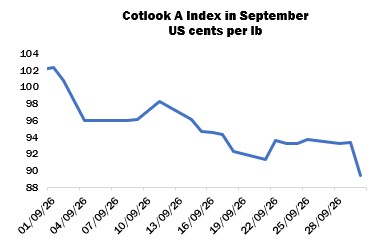
A much livelier pace of activity was reported as ICE futures fell back to the low 80s cents per lb, particularly since basis offers remained under pressure in many cases. The flurry of business subsided slightly later in the month, perhaps as some mills were satisfied with the supplies secured for the time being, although buying returned following the sharp fall of futures at the end of September. That said, downstream demand remained below expectations despite the arrival of the typical ‘peak season’ for textiles orders.
Even as local new crop arrivals picked up, buyers in Pakistan purchased cotton from various origins, including competitively priced recaps and lower grades. In Bangladesh, the customary West African and Brazilian styles found buyers, although reports of difficult operating conditions for spinners persisted. Mills in Turkey returned to the market, mainly in pursuit of Brazilian lots at low price levels, for nearby shipment as well as early next year. Buyers in the Far East also secured lint from that origin, as well as US cotton. Activity in China was relatively subdued, with interest mainly focused on State Reserve sales, consigned stocks at ports and the upcoming harvest of the domestic crop.
While Brazilian cotton was often the main focus for mill buyers in most quarters, US export reports demonstrated an uptick in buying for that origin too. In the four weeks to September 24, 578,000 running bales of upland were added to this season’s commitments, bringing the total to almost five million bales, ahead of the same moment a year ago but behind the pace of the previous nine seasons. Shipments in the period amounted to 634,000 bales.
Following presidential meetings in Washington at the end of September, China and the US agreed to cut tariffs on a range of goods, including US cotton entering China and certain home textile items in the other direction, although cotton textiles and apparel were not mentioned. The change may encourage purchases of US lint, and reports of increased enquiry for 2026/27-crop supplies circulated following the announcement.
Harvesting gradually expanded in the US, with work placed at 17 percent complete by September 27, two points ahead of last year and the five-year average. Crop conditions deteriorated slightly further over the month: the proportion of stands described as ‘good to excellent’ was 35 percent by the end of September, versus 39 percent by August 30. Those rated as ‘fair’ were 30 percent (29 a month earlier), while 35 percent were ‘poor to very poor’ (32 percent). In the key producing state of Texas, 52 percent of stands were rated as ‘poor to very poor’.
USDA cut its estimate of domestic production further in the latest WASDE, from 13.61 million bales to 13.2 million, primarily reflecting lower yields, while many observers indicated that eventual output may prove to be lower still as reports of abandonment increased. Globally, production was also reduced while exports were raised and the figure for consumption was maintained, with the result that the estimate for ending stocks was slightly lower than the figure put forward in August, at 69.86 million bales.
In China, the lead January contract on the Zhengzhou cotton futures platform fell sharply overall to stand on September 30 at 15,620 yuan per tonne, a decline of 1,440 yuan on the month and its weakest level since March. Virtually all cotton stands had entered the boll opening stage in the key Xinjiang region by the end of the month and initial harvesting began with work set to expand in October.
The 2026 State Reserve auction series concluded on September 29. The cumulative total dispersed amounted to almost 410,000 tonnes, more than 99 percent of the overall manifest. Of the supplies sold, approximately 58 percent was US cotton produced in 2020/21 and 2021/22, while 23 percent was Brazilian (2019 and 2021 crop). Xinjiang supplies from 2019/20 accounted for 19 percent of the tally.
New crop arrivals increased in Pakistan as picking accelerated under mostly favourable conditions. Field reports were positive overall, with pest infestations said to be limited and under control. According to the PCGA, seed cotton deliveries by September 30 amounted to 3.2 million lint equivalent bales, up five percent on the year, with Sindh accounting for 62 percent of the total.
Arrivals also picked up in India. The Southwest Monsoon began its withdrawal from the country on September 19, slightly later than normal. Overall rainfall across the country during the Monsoon season was below average.
Turning to the Southern Hemisphere, picking concluded in Brazil, while ginning was roughly halfway complete. Quality results thus far show a higher proportion of lower grade supplies than in recent seasons, but other parameters such as staple length are excellent. Some local output estimates were raised further. In Argentina, early sowing commenced in parts, and wide-ranging forecasts of planted area were put forward by observers.
Cotton Outlook’s estimate of global raw cotton production in 2026/27 was raised by 252,000 tonnes in September, to 25.38 million tonnes, owing to adjustments for several countries. Our forecast of consumption was meanwhile reduced by 52,000 tonnes to 26.42 million, as lower assessments for China and the US were only partially offset by higher numbers for Pakistan and Indonesia. The result would be a reduction of global stocks by the end of the current marketing year of 1,038,000 tonnes, versus the 1,342,000 put forward in August.
For the 2025/26 season, our world output figure was increased by 325,000 tonnes, attributed to Brazil and Australia, while consumption was adjusted modestly. Thus, the estimated addition to global stock levels by August 31, 2026, expanded to 557,000 tonnes.